We tend to think of peace as a state of rest. Some tranquil place where nothing happens. But peace is neither static nor passive. Rather, it is active. A deliberate choice. It is not the absence of war, which is often nothing more than an uneasy peace. It’s not about compromise or capitulation either, where to avoid conflict we keep the peace. Instead, it’s a state of calm readiness, in balance with ourselves, others and the world.
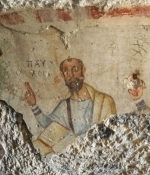
Few people know of Thecla today, but in the early Church this 1st century woman missionary was famous, working alongside Jesus’ key follower St Paul, a man whose preaching and writing shaped much of Christian thinking. She was even called “equal-to-the-apostles”. Yet she challenged not only the accepted position of women in Roman society but the entrenched patriarchal views of women’s role within the Church. She was also venerated as the first female Christian martyr and became a saint. So what was her story?
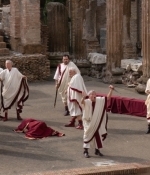
There have always been conspiracies. We only need to think back to Roman times, to the conspiracy to assassinate Julius Caesar, immortalised by Shakespeare. A group of Senators successfully plotted to kill him, accusing him of tyranny. The event was recorded by his respected contemporary Cicero and subsequently confirmed by half a dozen later Roman historians. The Senators had the motive and the means. No one seriously doubts it happened.
When I was 15, I was sent to a special educational unit for young people who, for different reasons, had found mainstream education difficult—and whom mainstream education had often found difficult too. Before I came to the educational unit, my life was already difficult. I had a very troubled home life and no real support system outside of education. There wasn’t anyone at home who could offer stability, emotional support, or help me make sense of what I was dealing with, and that inevitably showed in my behaviour. I was navigating situations and emotions that felt far bigger than me, without the support or language to explain what was going on.
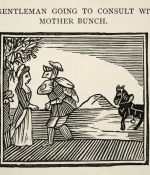
Although it is commonly thought that in medieval times women and men who were healers were often accused of being witches, at village level people clearly distinguished between benevolent practitioners of “natural magic” often called “cunning folk”, “wise women” or “wise men”; and malign users of magic which were usually identified as “witches”. In his book Instruments of Darkness, the historian James Sharpe identified four services provided by cunning folk:
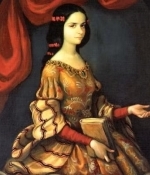
Imagine you are a nun in mid-17th century Mexico. You’re a brilliant scholar in an age where the best a woman can hope for is an advantageous marriage. A precocious child, you’re reading at three. At nine years old, with astonishing speed, you learn Latin and Greek and quickly absorb theology, science, and classical literature. Imagine you are a nun in mid-17th century Mexico. You’re a brilliant scholar in an age where the best a woman can hope for is an advantageous marriage. A precocious child, you’re reading at three. At nine years old, with astonishing speed, you learn Latin and Greek and quickly absorb theology, science, and classical literature. As a young teenager you join the household of the viceroy of Mexico City, who pits you against a roomful of renowned scholars. You hold your own.
This is the story of a man who wouldn’t fit into a box. In an age of increasingly entrenched and intolerant religious beliefs, his was a free spirit. The story of his life is one of searching, evolving, awakening till he arrived at an understanding of the spiritual world that we would recognise today. Yet in his time was denounced by the Catholic Church as a heretic and his books were burnt; and the Protestant leader Martin Luther called him "the devil's most cherished slanderous mouth".
As the political and media world are gripped with the issue of immigration and resurgent nationalism, it is ever more important that a clear spiritual vision is set out that offers a constructive way forward for humanity.
The Catholic Church did its level best to destroy not only every last Cathar but every last trace of them and very nearly succeeded. The whole machinery of Church and state – military, administrative, legal and religious – was employed to crush the ‘heresy’ that at one time seemed likely to undermine the power of Catholicism in southern France. Even so, it took over a hundred years to supress Catharism and a few their writings still survived. It is these that give voice to the movement that so terrified the Catholic establishment.
Leaders of nations are supposed to work for everyone’s good. At the bare minimum they should strive for political and economic stability and justice for all. Some may drive reform or promote social revolution. Others may be peacemakers. But what about forging a spiritual path for their people? Should leadership encompass a spiritual element? How would it benefit a political environment?
Our story begins with a small intuitive thought to read a freebie magazine that usually ended up going straight into the recycling bin. An article “The history of St Margaret, The Queen of Scotland” caught my eye, with an exhibition celebrating the 775th anniversary of her being made a saint, held at a nearby church named after her.
I first met Rābiʼa of Basra – as I then knew her – in a monastery of all places. Her story was nestling on a shelf in their library. It was a short biography by Sister Mary Paul, called Loving God for Himself Alone: An Appreciation of the Prayers of a Muslim Mystic Rabi’ah of Basra. As I was interested in discovering more about Islam, it intrigued me, especially because it concerned the life of a woman mystic, which is relatively uncommon in the Abrahamic religions.
Spirituality, unlike religion, cannot be easily classified. By its very nature, it has no fixed doctrine. It is both universal, coming from a source of spiritual light that fills the entire cosmos; and it is personal, as each one of us gives it a unique flavour. Yet we can also see people drawn to expressions of spirituality that share much in common.


-150-175.jpg)
-150-175.jpg)
-150-175.jpg)
-150-175.jpg)
-150-175.jpg)
-150-175.jpg)