
I first met Rābiʼa of Basra – as I then knew her – in a monastery of all places. Her story was nestling on a shelf in their library. It was a short biography by Sister Mary Paul, called Loving God for Himself Alone: An Appreciation of the Prayers of a Muslim Mystic Rabi’ah of Basra. As I was interested in discovering more about Islam, it intrigued me, especially because it concerned the life of a woman mystic, which is relatively uncommon in the Abrahamic religions. I wrote down some her prayers and sayings, which were very striking.
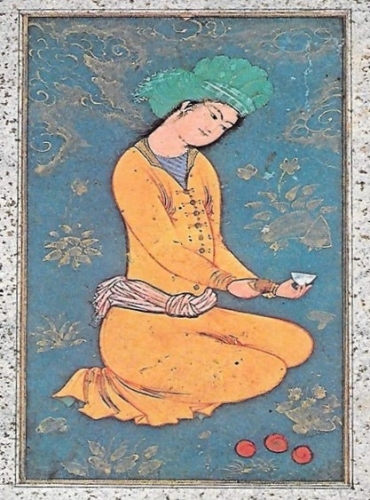
Rabia Sufi from Love Poems from God by Daniel Ladinsky., CC BY-SA 4.0
<https://creativecommons.org/licenses/by-sa/4.0>, via Wikimedia Commons
A Life Embracing the Spirit
Rābiʼa Al-ʼAdawiyya to give her full name, lived in 8th century Basra in what is now Iraq. She seemed to be a person almost consumed by her single-minded devotion to God. She came across as a person of great spiritual power and slightly fearsome with it, rather like Joan of Arc, or even Greta Thunberg. Evidence suggests she may have been a freed slave. Embracing a life of poverty and ascetism, she refused to be distracted by anything or anyone that stood in the way of her spiritual work as she understood it. The 12th-century Islamic scholar Ibn al-Jawzi, whose history of the world included biographies of people he considered noteworthy, gives a story of a friend of hers, Muhammed bin ‘Amr, who said:
“I went into Rābiʼa, and she was a very old woman of eighty years, as if she was a worn-out skin almost falling down, and I saw in her house a reed mat and the curtain of the house was made of palm leaves, and perhaps there was a mat and an earthen jug and a bed of felt, which was also her prayer carpet.”
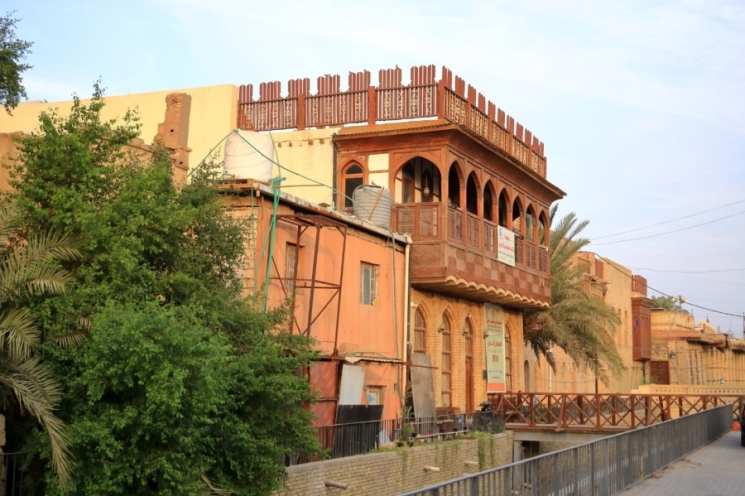 A scene from the old Al Ashar Quarter in Basra today
Spiritual Message
Although the key facts of her life are recorded by a few early sources, a great deal of uncertainty surrounds what Rābiʼa Al-ʼAdawiyya really did say or write down as opposed to what has been attributed to her later. Nevertheless, she holds a revered position within Islam, especially in its mystical wing, Sufism. In Mary Paul’s book, there is at least a consistency in her message with her other writings found elsewhere. A characteristic saying of hers sets out her relationship with the Divine:
“I have not served God from fear of Hell, for I should be like a wretched hireling, if I did it from fear; nor from love of Paradise, for I should be a bad servant if I served for the sake of what was given, but I have served Him only for the love of Him and desire for Him.”
Rābiʼa challenges the prevailing mindset of people of all religions up to the present day. This is a theology based on avoiding punishment and seeking reward. I had a conversation with an Evangelical Christian once who offered me joys of heaven if I followed his religion and threatened the fires of hell if I didn’t. And I asked him, “Where is the nobility in this faith of yours? It’s just self-interest.” He had no reply.
In Rābiʼa’s case it is, as the book title says, ‘Loving God for Himself Alone’. It is unconditional spiritual love, neither from fear or in hope of reward, and thus spirituality in its highest form. This issue affects every aspect of our lives, whether we are secular or spiritual. Doing something simply because it is the right thing to do, even if no one knows about it or it gains no credit with anyone in heaven or on earth, is a morality worth aspiring to. In this sense, humanists can be more truly spiritual than the ostensibly religious.
If our spirituality is not based on punishment and reward, what is it that motivates us? Again, Islam has an interesting answer: it is said that “Every child is born a Muslim.” In its broadest sense, we could say have an innately pure nature that will draw us towards our Divine source. It’s like we have our own homing beacon inside of us. And that is what we can listen to. It’s always here: sometimes its ‘beeps’ are soft and we easily ignore them; sometimes the circumstances of our lives mean the ‘beeps’ grow louder, whether through a crisis or a moment of awakening that seems to come out of nowhere.
A Beautiful Prayer
If tradition is correct, Rābiʼa has also given us a beautiful prayer. It is said she would go out on her roof, which was flat as it often is in Middle Eastern cities, and pray all night. She would begin her devotions thus:
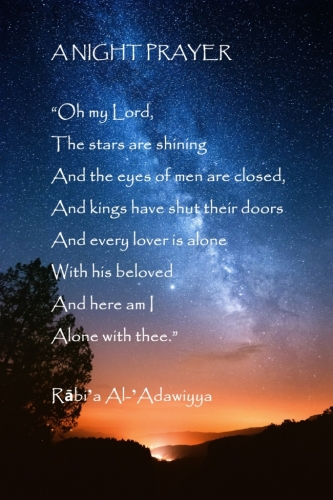
To me it has a personal warmth and intimacy interwoven with an absolute devotion to God that is spiritually intoxicating and so rarely found in the Western Christian tradition.
Rābiʼa and Womankind’s Spirituality
I wanted to learn more about Rābiʼa. At the time, I couldn’t find anything much in bookshops or on the internet. In a letter to my aunt Jasmine in South Africa I mentioned the difficulty I was having. My aunt had an old Muslim friend who with great kindness sent me a copy of Rabi’a the Mystic & her Fellow-Saints in Islam by Dr Margaret Smith. Delving more deeply into her spiritual thinking, it also described many other spiritually revered Muslim women. One of the things that also came across was the parallel between the changing position of women in both Islam and Christianity through history. In the early years women in both faiths held a much more prominent position spiritually – they were also women Islamic rulers and even warriors – but over time this was gradually eroded by the dead hand of patriarchy till they became largely marginalised. Yet throughout history there have been extraordinary women who spoke with spiritual authority, challenging the prejudice of their age.
Though my travels in spirituality with Rābiʼa Al-ʼAdawiyya began a quarter of a century ago, the more I discover, the more her unfolding story challenges me to experience more deeply the Divine.
By Simenon Honoré
With special thanks to Jasmine Herbert and Sheik & Zeinab Dien.
You may also be intersted in watching this short video about the life of Rābiʼa Al-ʼAdawiyya.
The views expressed in this article are not necessarily those of Spirit of the Rainbow.
If you enjoyed this article, share it with a friend. And why not sign up for our newsletter?
Popular posts
You might also like
Email Newsletter Our latest articles and offers delivered straight to your inbox.