
“Of royal blood she sprang, but nobler far
God’s service found than pride of royal blood.”
Bede, 8th century Chronicler, writing about Queen Aethelthryth in
Ecclesiastical History of the English People
Our story begins with a small intuitive thought to read a freebie magazine that usually ended up going straight into the recycling bin. An article, The History of St Margaret, the Queen of Scotland, caught my eye, with an exhibition celebrating the 775th anniversary of her being made a saint, held at a nearby church named after her.
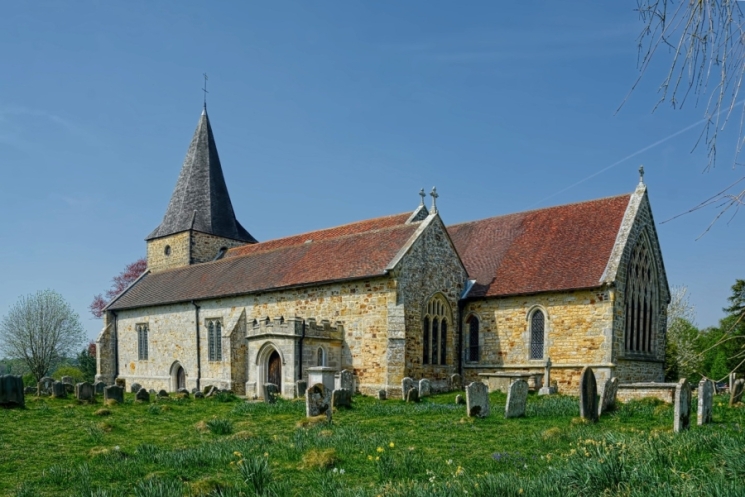
The Parish Church of St. Margaret the Queen, Buxted Park, East Sussex, England
The exhibition that was both beautiful and educational, was the creation of Stephen Law, a Trustee of The Friends of St Margaret the Queen, Buxted. He gave generously of his time introducing me to the story of St Margaret and sending me materials and guidance for further research. One of the things he said was that St Margaret was seen as a model of how a Christian monarch should behave and this opened a new horizon for exploring spiritual people in power.
The Making of a Saint
Margaret was a member of the Anglo-Saxon royal family, but she grew up in exile in Hungary. Her grandfather, Edmund Ironside, had been King of England but she and her family were forced to flee when the Viking Cnut conquered the realm. She returned after he died when her family were reinstated as rulers, with Edward the Confessor as king. After the Norman conquest, she was forced to flee again when her brother Edgar took part in a rebellion against King William. They took refuge in Scotland, then an independent kingdom, where she married the reigning monarch, Malcolm III. They ruled together from 1070 till they both died in 1093.
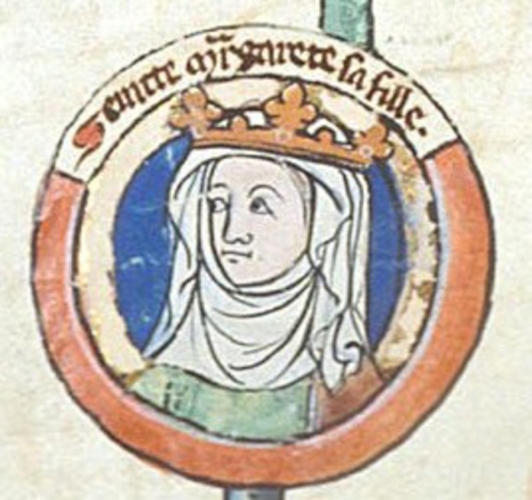
St Margaret, Queen of Scotland, detail from a 13th century family tree
It was during this period of almost a quarter of a century of rule that earned her canonisation as a saint. But was it possible for a medieval ruler to be both spiritual and in power?
In answer, we see that from her time in exile, Margaret had followed a spiritual practice based on the teachings of St Benedict, with prayer, psalms and fasting, and continued to do so after she became queen. Margaret took her religion seriously.
She sought to put her Christian principles into action as queen. Her biographer, Turgot, wrote that “when she went out in public either on foot or by horse, a small assembly of poor, orphans, and widows streamed together, as to a most pious mother, none of whom ever went away from her void of hope” and even got her courtiers to give their money too.
She also supported religious foundations, including funding the rebuilding of the monastery at Iona, after it had been destroyed by Viking raids.
The issue of church reform was more controversial. Although Scotland was Catholic, its practices, many of which came from the Celtic tradition, were different from the rituals of the Church in Rome. She is credited with bringing the Church in Scotland in line with the Catholic mainstream without a major quarrel. She may well have believed she doing God’s work but through 21st century eyes, would we call this spirituality in action?
After her death in 1093, a cult developed around her shrine and over 40 healing miracles were recorded. Margaret seems to have been canonised in 1250. But was being made a saint anything more than a reward for being a dutiful daughter of the Church? Or can we see in Margaret an example of spirituality in power?
Margaret Beyond the Myth
The historian Catherine Keene explained that in the 11th century,
“Queens were judged according to the extent to which they were a positive, specifically Christian, influence on their husband and by extension the realm.”
Jane Chance, in her book Woman as hero in Old English literature adds that a woman’s role was meant to be “the peaceful and peace-making complement of the warring male.”
In Margaret’s case, many English accounts describe her Scottish husband, Malcolm III as a semi-pagan savage though the historical record shows him as an astute statesman who spoke several languages. Though she would have needed his agreement for any significant initiatives, they seemed to have worked well together, “a partner to the king” as Turgot describes it.
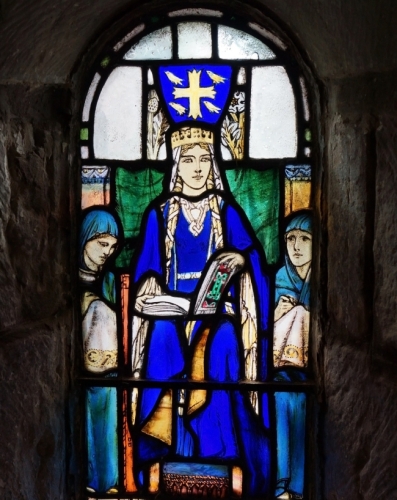
Stained glass window, St Margarets Chapel, Edinburgh Castle
There were areas however where Margaret went beyond her predetermined role. Above all it was in her hands-on approach to helping the poor that marks her out in terms of human compassion and spirituality in action. Turgot records:
“And she had nine little children, abandoned by every aid, brought in to her on the first hour of the day for nourishment. And so she had ordered to be prepared daily the softer foods by which this young age was delighted. She herself put them on her bent knees (lap) for feeding, and she made little drinks for them.”
Interacting directly with the poor in this way was very unusual for a queen, whose conventional piety was usually confined to giving money to churches and charities.
Her active role in the controversial church reforms suggests a dynamic, rather than the traditionally passive, role assigned to queens. She was praised by Turgot for correcting the “errors” of in the Scottish tradition and conversely also criticised as a foreign monarch for trying to erode the independence of the Church in Scotland. It may in fact be a case of her being “wise as serpents, and innocent as doves” (Matthew 10:16), astutely denying William the Conqueror a religious excuse to invade a “heretical” Scotland with papal blessing, as he had done with England in 1066. It is certainly true she supported diverse forms of Christian worship in Scotland, including the Celtic tradition of Culdee communities, so she cannot be seen simply as an agent of the Church of Rome.
Spirituality in Power?
Margaret’s spirituality was constrained in all sorts of ways. The first – and this is true of all of us – are the limits imposed by any rigid belief system, and Margaret was a strict Catholic. Within those confines, however, she clearly expressed a spiritual warmth which was rare for someone in her position. Secondly, she was also constrained by her role as woman which, even as a queen, was subservient to her husband in accordance with the misogynistic hierarchy of her age, which as far as we know, she accepted. She had no source of independent power, unlike, say, Henry II’s wife, Eleanor of Aquitaine, with lands and great wealth of her own. All she did, she achieved by the strength of her spiritual convictions and powers of persuasion. As the Buddhist T.D. Lakha Lama said, “Spirituality is spirit-in-reality” and Margaret’s reality was being a woman in medieval Christendom. Yet despite the constraints of Margaret’s life and times, she was nonetheless able to bring a spirituality to her role as queen.
By Simenon Honoré
Acknowledgements:
I gratefully acknowledge the use of the unpublished Dissertation by Catherine Keene on Saint Margaret, Queen of the Scots: Her Life and Memory.
A special thanks to Stephen Law for his help and encouragement in my exploration of this topic.
The views expressed in this article are not necessarily those of Spirit of the Rainbow.
If you enjoyed this article, share it with a friend. And why not sign up for our newsletter?
Popular posts
You might also like
Email Newsletter Our latest articles and offers delivered straight to your inbox.