
“People do not want the truth. They want to be told what they believe is true.”
– Anonymous meme
There have always been conspiracies. We only need to think back to Roman times, to the conspiracy to assassinate Julius Caesar, immortalised by Shakespeare. A group of Senators successfully plotted to kill him, accusing him of tyranny. The event was recorded by his respected contemporary Cicero and subsequently confirmed by half a dozen later Roman historians. The Senators had the motive and the means. No one seriously doubts it happened.
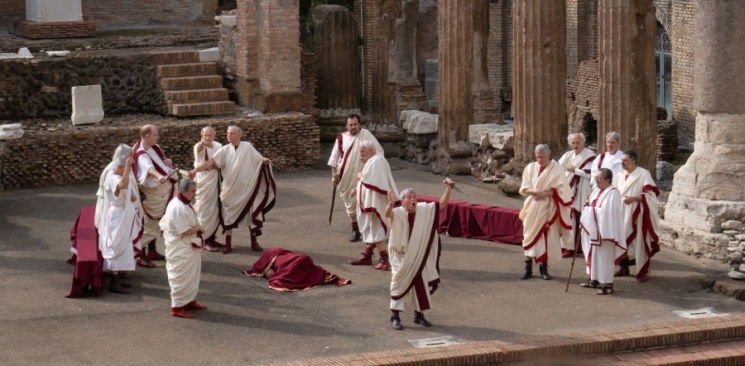
Historical re-enactment of the assassination of Julius Cesar 44 BC, by the Gruppo Storico Romano at Largo di Torre Argentina. Rome, Italy - March 15, 2024
About a hundred years later, Romans were told of another conspiracy. A fire broke out in Rome in 64 CE, for which the Emperor Nero was widely blamed, either for actually started it or failing to put it out. The Roman historian Tacitus wrote:
He [Emperor Nero] falsely charged with guilt, and punished with the most fearful tortures, the persons commonly called Christians, who were [generally] hated for their enormities.”
In the West, conspiracy theories have a long and inglorious history
“Hated” is the key word here. Nero picked a group that he knew were unpopular, calculating that people would all too readily believe the worst about them. There was of course, not a shred of evidence to support the accusation of a conspiracy and early Christians were generally against violence and destruction in principle, as well as having absolutely nothing to gain to setting fire to Rome.
Conspiracy Theories over the Centuries
But that is the point of conspiracy theories: the evidence is of little interest because there is no real quest for the truth but rather a search for confirmation of an existing belief, targeting individuals, groups or institutions that are already unpopular. It is important to distinguish between acknowledging the existence of conspiracies, of which there certainly have been plenty over the centuries, and being a conspiracy theorist, which is a way of viewing the world. Here the default mindset is to explain events in terms of shadowy powers, malign minorities, hidden networks, regardless of if there is any evidence of their existence or any logic to the stories.
In the West, conspiracy theories have a long and inglorious history and often have been (and still are) at heart anti-Semitic. In the Middle Ages, it was widely believed that there was a conspiracy between lepers, Muslims and Jews to poison wells, heightened at times of economic distress or outbreaks of disease like the Plague, for which they were blamed. Soon a connection was made with the Devil, supposedly masterminding these nefarious plots. Thousands were arrested, tortured, forced to confess and executed.
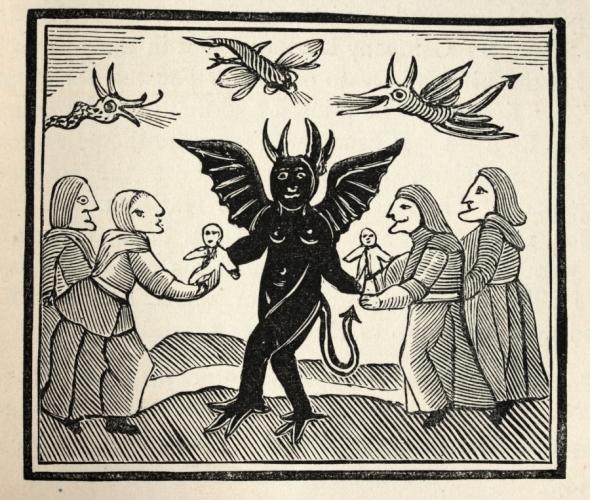
Summoning a Demon, illustration of from an 18th Century Chapbook, The Witch of the Woodlands, or the Cobler's New Translation
In later centuries Satan was also said to be behind an international conspiracy of witches. Here again unsubstantiated accusations against often marginalised or unpopular individuals led to forced confessions and a variety of gruesome punishments. In early modern Europe, it is estimated over 50,000 people, mainly women, were executed. It wasn’t until the rationalist Enlightenment of the 18th century that these conspiracy theories were seriously challenged.
Unsubstantiated accusations against often marginalised or unpopular individuals led to forced confessions and a variety of gruesome punishments
Modern Conspiracy Theories
Paradoxically the 18th century gave birth to a conspiracy theory that has lasted to the present day: the Illuminati. Based in Bavaria, they were one of a number of groups set up by Enlightenment thinkers who opposed tyranny whether from the state or Church. The Illuminati sought to use reason to improve the wellbeing of humanity with the ultimate aim of establishing a universal democratic republic. Their founder, Adam Weishaupt, wrote in his book, The Lantern of Diogenes (1804):
“Man will recover from his fall; princes and nations, without violence to force them, will vanish from the earth; the human race will become one family, and the world the habitation of rational beings.”
The group was beset by all sorts of internal divisions as well as a fractious relationship with the Free Masons, then another emerging Enlightenment organisation. The Illuminati group was soon suppressed by the authorities and its members scattered and that, for all practical purposes, was the end of it. It is hard to see at first glance how anyone today could object to the Illuminati, but it had two features which gave rise to it being labelled as an evil international conspiracy. The first was that it was a secret society; the second was it was part of a network of Enlightenment thinkers including the future leaders of the new government of the United States of America, among them President Thomas Jefferson, who explained in a letter written in 1800:
“As Weishaupt lived under the tyranny of a despot and priests, he knew that caution was necessary even in spreading information, and the principles of pure morality…This has given an air of mystery to his views…If Weishaupt had written here, where no secrecy is necessary in our endeavours to render men wise and virtuous, he would not have thought of any secret machinery for that purpose.”
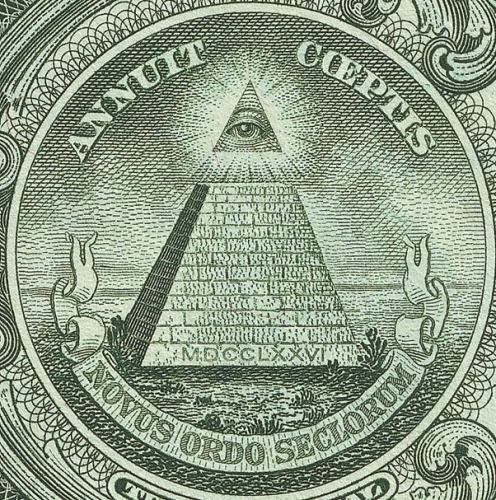
The symbol of the all-seeing eye is on the US one dollar bill, and in the original French Declaration of the Rights of Man. Some have seen this as evidence of the Illuminati conspiracy, although it was not their symbol, which was the Owl, symbol of the Roman Goddess of Wisdom
The Illuminati sought to use reason to improve the wellbeing of humanity
Unsurprisingly the Illuminati shared similar Enlightenment ideas with not only the leaders of the American Revolution but the French Revolution too. They found themselves however, being accused of having masterminded these revolutionary movements, first by the authorities but in later centuries in the popular imagination. Bizarrely this conspiracy theory became entwined with another, older myth of an international Jewish conspiracy and even a further twist in which they were in cahoots with the Catholic Church, which in reality had done its utmost to destroy them.
The Conspiracy Mindset – and its Antidote
We may wonder how this conspiracy theory about the Illuminati ever got wings, let alone occupied the prominent position it does amongst conspiracy theorists today. Stories like these seem to come from a sense of powerlessness, an experience of life being out of our control, our fate in the hand of unseen forces. It is only one step away from giving this sense a name, a label, an organisational form, and link it with existing prejudices. Its signature emotions are fear and suspicion, even paranoia. None of this helps humanity. It offers no real solutions, it feeds the darkest imaginations and feelings of victimhood. It is often immune to reason because its source is a visceral fear, not some intellectual process. Even when Pope Clement VI issued a papal decree in 1348 denouncing the conspiracy theory that accused Jews of causing the Black Death, few listened.
Conspiracy theories can be dangerous: wild accusations without proof have led to anti-Semitic pogroms, witch persecutions, and in modern times individuals and groups targeted online and in person based on mere rumour. But we can choose instead to investigate what may (or may not) be conspiracies intelligently. We can look for hard evidence rather than unsubstantiated assertions; we can ask common sense questions about means and motive; we can check out the source of these accusations and any agenda that they may have; we can test the case in the courts rather than trial by media; we can listen to real experts rather than self-appointed internet gurus; and above all we can be wary of believing what we want to believe rather than hearing a truth, however uncomfortable it is. Rather than lose ourselves in never-ending speculations about possible conspiracies, we have it in our power to search for truth and justice, long and hard though the road may be.
By Simenon Honoré
The views expressed in this article are not necessarily those of Spirit of the Rainbow.
To discover more about the history of conspiracy theories and the forces that guide our lives, try reading: Riverlution: Going with the flow of personal and planetary change.
If you enjoyed this article, share it with a friend. And why not sign up for our newsletter?
Popular posts
You might also like
Email Newsletter Our latest articles and offers delivered straight to your inbox.