
Few people know of Thecla today, but in the early Church this 1st century woman missionary was famous, working alongside Jesus’ key follower St Paul, a man whose preaching and writing shaped much of Christian thinking. She was even called “equal-to-the-apostles”. Yet she challenged not only the accepted position of women in Roman society but the entrenched patriarchal views of women’s role within the Church. She was also venerated as the first female Christian martyr and became a saint. So what was her story?
The Acts of Paul and Thecla
It wasn’t till around 200 CE that the Christian Church more or less settled on what would or would not be included in their official Bible. One of the texts that didn’t make the cut, though it was widely read at the time, were the Acts of Paul, which included the story of Thecla. So what was it about the text that was so controversial? There are several versions.
The story begins in Iconium, (Konya in modern Türkiye) where a young noble woman, Thecla, sitting at her window, hears Paul preach. Transfixed, she stays there for three days to the consternation of her mother, Theocleia, and fiancé, Thamyris, who fear she is going to abandon her marriage and follow Paul’s teaching which advocated chastity:
“Blessed are the bodies and souls of virgins; for they are acceptable to God, and shall not lose the reward of their virginity.”
As a result, Paul and Thecla are brought before the governor who orders that Paul be flogged and expelled from the city. Thecla’s fate is much worse:
“Theoclia, her mother, cried out, saying, Let the unjust creature be burnt; let her be burnt in the midst of the theatre, for refusing Thamyris, that all women may learn from her to avoid such practices.”
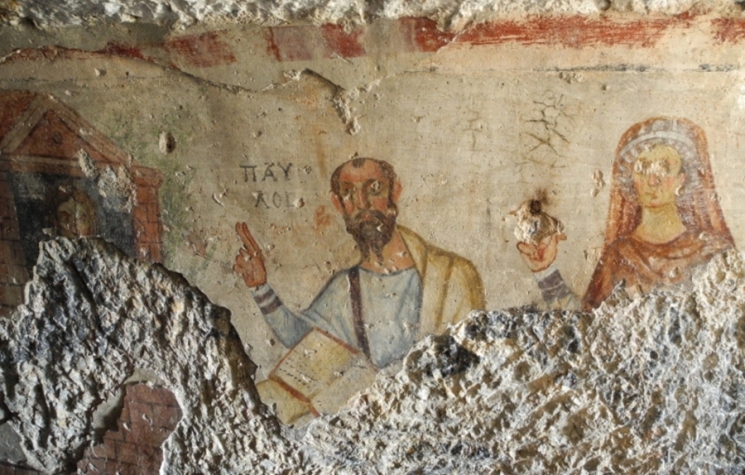
This act of spiritual empowerment, when a woman baptises herself, ran against the deep patriarchal grain of Church thinking
But in the first of many miracles, God intervenes to put out the fire. Thecla catches up with Paul, and they travel together to Antioch, where she encounters more trouble. This time she refuses the advances of another powerful dignitary, Alexander. She is condemned to be eaten by wild animals but once again, she is saved by Divine intervention:
“But a she-lion, which was of all the most fierce, ran to Thecla, and fell down at her feet. Upon which the multitude of women shouted aloud.”
It is at this point the story of Thecla becomes truly revolutionary:
Afterwards they brought out many other wild beasts; but Thecla stood with her hands stretched towards heaven, and prayed; and when she had done praying, she turned about, and saw a pit of water, and said, ‘Now it is a proper time for me to be baptised.’ Accordingly she threw herself into the water, and said, ‘In thy name, O my Lord Jesus Christ, I am this last day baptised.’ ”
This act of spiritual empowerment, when a woman baptises herself, ran against the deep patriarchal grain of Church thinking. In the light of these miraculous events, she is pardoned by the Roman governor:
“Upon which the women cried out together with a loud voice, and with one accord gave praise unto God, and said; There is but one God, who is the God of Thecla; the one God who delivered Thecla.”
Thecla, contravening all social and religious norms, dresses as a man, and goes off in search of Paul. This act of rebellion is compounded by her next move:
Then Thecla arose, and said to Paul, I am going to Iconium. Paul replied to her: Go, and teach the word of the Lord.
The idea of women preaching was (and in most Churches still is) regarded as unacceptable. Eventually she goes to live in cave, healing and teaching, attracting a following amongst women. Even in old age she faces violent misogyny, with a gang of men trying to rape her. At this point God shows her a way to disappear into the rock itself and her life ends. Other versions have her journeying to Rome to visit Paul’s tomb and even being buried beside him.
The idea of women preaching was (and in most Churches still is) regarded as unacceptable
Fact or fake?
Viewed through 21st century eyes, parts of this story seem fantastical – the divine dousing of a fire, the celestial calming of wild beasts, for example, but in the early Christian Church those were not the elements that made them question its authenticity. Rather it was the feminist content and discrepancy with Paul’s known attitude towards women, which raised suspicions. Tertullian, the Christian writer (c.155 - 220 CE), claimed it was a forgery:
"But if certain Acts of Paul, which are falsely so named, claim the example of Thecla for allowing women to teach and to baptise, let men know that in Asia the presbyter who compiled that document, thinking to add of his own to Paul's reputation, was found out, and though he professed he had done it for love of Paul, was deposed from his position. How could we believe that Paul should give a female power to teach and to baptise, when he did not allow a woman even to earn by her own right? Let them keep silence, he says, and ask their husbands at home" (XVII.5; cf. I Corinthians, 14:35, "And if they will learn anything, let them ask their husbands at home: for it is a shame for women to speak in the church").
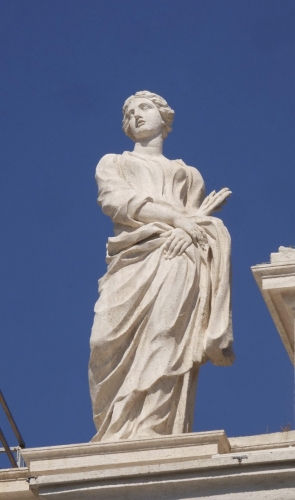
Statue of Thecla, Colonnade, Basilica, St Peter's, Rome
The description of Paul is certainly inconsistent with what we know but there are a couple of caveats to Tertullian’s dismissal of the entire text as a worthless forgery. First, that Paul’s itinerary largely matches that in the Acts of the Apostles and Paul’s Epistles; secondly, that Tertullian was a notorious misogynist and would be unlikely to want to give any credit to a story of female empowerment. It is quite possible Thecla’s story is an embroidered version of a real person’s life, reflecting the views of those in the early Christian Church which sought to give women their spiritual voice.
Thecla’s Legacy
Whatever the Church’s reservations, a widespread cult developed around Thecla between the 3rd and 7th centuries and she is still revered today especially in the Eastern Orthodox Church, such as Monastery of Saint Thecla at Maaloula, Syria.
The savagery of her punishments are testament to how her actions threatened patriarchal authority

Gorge leading to the Monastery of St. Thecla, Maaloula, Syria
But Thecla’s legacy goes beyond that.
Professor Alicia D. Myers, in her article Motherhood and the Early Christian Community (Biblical Archaeology Society, September/October 2018) explains that:
“In the Roman world, good girls became mothers…In fact, many ancient philosophers and medical authors believed that motherhood was a woman’s sole purpose in creation.”
Thecla challenged that view of womanhood and through her celibacy sought to be free to follow her own spiritual path. She broke with the social norms and the savagery of her punishments are testament to how her actions threatened patriarchal authority.
The Church’s view of celibacy was more complex. There was a view – St Paul certainly held it – that celibacy was the preferred but not essential option, perhaps because they believed the end of days was near. His advice to men was:
“Do not look for a wife. But if you do marry, you have not sinned; and if a virgin marries, she has not sinned.” (1 Corinthians 7:26-7.28)
He was however at one with the Roman view of the subordinate position of women as Tertullian pointed out. It was not, however, the only view in the early Church as there was a sizeable minority, under the umbrella label of “Gnostics”, where women had a spiritual voice, some groups even having women bishops. And if we draw on the Gospel of Philip (another text that didn’t make it into the ‘official’ Bible), we see women were key to Jesus’ mission:
“There were three who always walked with the Lord: Mary, his mother, and her sister, and Magdalene, the one who was called his companion.”
It is in this context that we need to see the story of Thecla. Whether her life was symbolic or lived, it was profoundly revolutionary, blazing a trail for future generations of women to assert their own spirituality.
By Simenon Honoré
The views expressed in this article are not necessarily those of Spirit of the Rainbow.
If you enjoyed this article, share it with a friend. And why not sign up for our newsletter?
Popular posts
You might also like
Email Newsletter Our latest articles and offers delivered straight to your inbox.