
“Most men are wont to seeke after these wise men, and cunning women, such as they call witches, in sicknesse, in losses and in all extremities.”
- Henry Holland, clergyman, 1590
Although it is commonly thought that in medieval times women and men who were healers were often accused of being witches, at village level people clearly distinguished between benevolent practitioners of “natural magic” often called “cunning folk”, “wise women” or “wise men”; and malign users of magic which were usually identified as “witches”. In his book Instruments of Darkness, the historian James Sharpe identified four services provided by cunning folk:
However, healers and cunning folk generally were well thought of by their community
By contrast, witches were people, mainly women, accused of doing harm using occult means – “maleficium” to give it its legal name in Latin, such as souring milk, causing infertility or infant death and cursing. There were always tensions in the village over accusations against individuals, which rumbled on, occasionally bursting into acts of violence or lawlessness. Overall, however, healers and cunning folk generally were well thought of by their community.
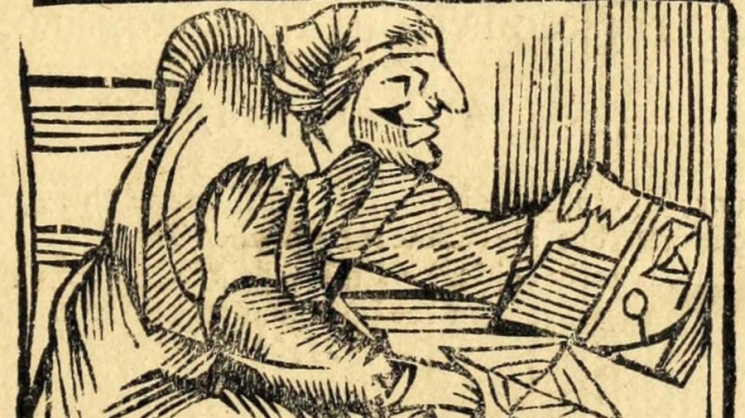
Illustration of from an 18th century Chapbook, A gentleman going to consult with Mother Bunch
Attitudes of the Authorities
There was, however, another world, the world of the authorities, of magistrates, town councillors, the Church and the landed class all the way up to the king. Their interest in village affairs was mainly limited to issues of law and order. Their attitude to cunning folk varied considerably. Sometimes it was benign: rural doctors were said to consult them when dealing with patients supposedly affected by witchcraft, though later the medical profession was to unsuccessfully try to persuade Parliament to legislate against the medical work of cunning folk. Members of the clergy were likely to be more hostile. The religious thinker William Perkins accused them of working with the devil, who was seen as a very real and ever-present threat to people’s lives.
“The ministers of Satan, under the name of wise-men and wise-women, are at hand, by appointment, to resolve, direct, and helpe ignorant and unsetled persons, in cases of distraction, losse, or other outward calamities.”
This linking of witches and even cunning folk with the devil, as part of a world-wide Satanic conspiracy, was to have serious consequences for the wise women and men of the village. It was strongest in Continental Europe and Scotland. In Germany in 1487 a best-selling guide to witchcraft, the Malleus Maleficarum or Hammer of the Witches claimed the practice was based on a pact with the Devil. This idea of a link with the devil had much less influence in England at this time, though it slowly grew over the century.
This linking of witches and even cunning folk with the devil, as part of a world-wide Satanic conspiracy, was to have serious consequences
Nevertheless, in 1542 a short-lived Act of Parliament was passed, mainly directed against “maleficium” such as:
“...witchcrafts, enchantments, and sorceries to the destruction of their neighbours’ persons and goods”
But it also included finding lost and stolen goods by magic, which fell under the remit of cunning folk. The act was repealed but another act was introduced in 1563, though court cases seem to have been on charges of maleficium rather than natural magic generally.
The Story of Mother Shipton
It was into this world that Ursula Southeil, who later became known as “Mother Shipton” was born, it was said, around 1487 or 1488, about the time Malleus Maleficarumcame out. Although she became famous in later centuries, we cannot be certain she existed, with only limited circumstantial evidence such as the reference to “a witch of York” by Henry VIII in one of his letters. The consensus amongst historians is that she probably did, though her story may well have been embroidered over the ages. Legend or not, Mother Shipton’s life tells us a great deal about attitudes to 16th century healers in England.
Engraving from The Strange and Wonderful World of Mother Shipton (1686) of Ursula Southeil,
or “Mother Shipton” (c.1487 – 1561)
The story goes she was born in was born on a dark and stormy night to a destitute teenage mother, Agatha. Ursula was said to be hideous in appearance from the first, with a hunched back, crooked nose and warts. Both rejected by the local community, Agatha brought up her child in a cave in the woods, till a local Abbott offered to find a family to look after her daughter, while her mother was sent to a nunnery far away, never to see her Ursula again.
Mother Shipton’s life tells us a great deal about attitudes to 16th century healers in England
Ostracised by locals, Ursula spent much time in the woods where she perfected her craft as an herbal healer. Slowly she began to win respect from the community for her skills. Later she was to marry a carpenter, Tobias Shipton, from whom she got her name. She also began to prophesy, first about local events, such as the collapse of a Church steeple during a storm. Later she made claims about national events, including, it is said, that Cardinal Wolsey, who was effectively Prime Minister at the time, would never reach York, the seat of his Archbishopric. If she did, she was literally taking her life in her hands, because prophesying about the fate of the rich and powerful was extremely dangerous in an age when it was treason to prophesy the death of a monarch. Wolsey was said to have threatened to execute her if he ever got to York. Luckily for her, he died on the way. Despite the controversy surrounding her life, Mother Shipton died at the age of 73.
Lessons of Mother Shipton’s Life
The story of Mother Shipton illuminates important issues about the way society operates, even today.
The first concerns the link between ugliness or deformity and evil. Ugliness is entirely subjective, existing only in the mind of the beholder, but the social conventions on what constitutes an attractive or an ugly person are enduring. We can trace the identification of ugliness with wickedness back at least as far back as the Roman poet Ovid in describing the evil character Dipsas as ugly and this association has persisted. Even in recent times there has been a tradition in Hollywood of conventionally good-looking characters being the heroes or heroines, and villains always being ugly.

"Mother Shipton" Moth (Callistege mi), said to have a likeness of her profile on its wings
Ugliness is entirely subjective, existing only in the mind of the beholder
The second issue is the power of authorities in formulating laws and shaping opinion about minority groups. That Mother Shipton was never prosecuted for witchcraft though she may have come close to it over the Wolsey affair reflects the relatively moderate thinking of 16thc English elites. In the 17th century, James I created a much more hostile environment, leading to outbursts of witch crazes. The same holds true today of political leaders, for example, in influencing policies and attitudes to migrants or transgender people.
Thirdly, is the terrible damage caused by conspiracy theories. In this case, linking individual acts of witchcraft to a mythical demonic network was to lead to the death of upwards of 50,000 people, mainly women, in early modern Europe. This had been preceded by an even older conspiracy theory involving Jews, Muslims and lepers poisoning wells, which was to morph into the antisemitic forgery in the early 20th century, The Protocols of the Elders of Zion which in turn fed into what was to become the Holocaust. There are variants of these conspiracy theories even today.
Despite the suspicion and hostility they faced, 16th century healers could provide help to the poorest and most marginalised in society, for whom conventional medicine was too expensive. They carried the wisdom and knowledge of generations and their work deserved to be recognised.
By Simenon Honoré
The views expressed in this article are not necessarily those of Spirit of the Rainbow.
If you enjoyed this article, share it with a friend. And why not sign up for our newsletter?
Popular posts
You might also like
Email Newsletter Our latest articles and offers delivered straight to your inbox.