
“She studies, and disputes, and teaches, and thus she serves her Faith; for how could God, who gave her reason, want her ignorant?”
— Sor Juana Inés de la Cruz
Imagine you are a nun in mid-17th century Mexico. You’re a brilliant scholar in an age where the best a woman can hope for is an advantageous marriage. A precocious child, you’re reading at three. At nine years old, with astonishing speed, you learn Latin and Greek and quickly absorb theology, science, and classical literature. As a young teenager you join the household of the viceroy of Mexico City, who pits you against a roomful of renowned scholars. You hold your own. At about the age of twenty, however, you take the veil. Why? Because convent life will allow you the freedom to continue your studies. A choice no man has to make.
From your nun’s cell you explore all known fields of discipline. You are sought after by the intelligentsia. You amass a vast library of 4,000 books, scientific tools and musical instruments. You are a playwright and poet. You study musical theory and compose hymns alongside rigorous works of theology and logic. You criticise gender inequality. You are derided for your “masculine and unrefined writing”. You dismantle theological arguments and are taken to task. You counter with a courageous and brilliant defence of women’s right to education. Men of the cloth are not impressed. This does not bode well for you.
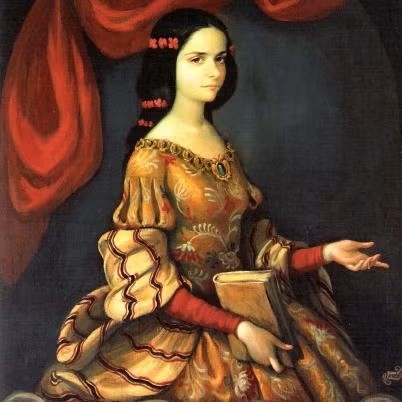
Portrait of Sor Juana at 15, when she first entered the viceregal court. 17th century, artist unknown
Who was Sor Juana Ines de la Cruz?
Juana Inés de Asbaje Ramírez de Santillana was born in San Miguel de Nepantla, Mexico in about 1648 to an unwed Creole mother and Spanish naval captain who abandoned the family shortly after her birth. Her low social status and early years spent in a humble hacienda may have awakened in her an awareness of the disadvantages that others had to endure. Her extraordinary talents were recognised from childhood, but it was Juana’s own ambition and determination that fuelled her burning desire to study.
Women entered convents in the 17th century mainly to devote themselves to religious life or escape economic hardship. For Juana it was a means to an end. Away from the demands of marriage and child rearing at the Convent of Santa Paula she could focus on her studies and gain status in her own right.
Her extraordinary talents were recognised from childhood
Convent life as a means to intellectual freedom
Sor (Sister) Juana Ines de la Cruz, as she became, acted as the convent’s accountant and archivist, but also held gatherings for the court’s leading artists, writers and thinkers under the patronage of the viceroy of New Spain. The viceroy’s wife, marquise de la Laguna, was major supporter, even ensuring that her poetry anthology was published in Spain.
From behind convent walls between the 1680s to 1690s Sor Juana produced an extraordinary body of work covering philosophy, theology, science, mathematics, astronomy and rhetoric. She also produced literature, painting and music.
Her literary output encompassed plays, prose and poetry, including love poems – the most passionate addressed to Maria Luisa de Manrique. Some scholars view these poems in the context of “soul-love”, a profound, spiritual connection that transcends physical attraction. Modern feminist critics, however, see this as an attempt to erase the intense sensuality of Sor Juana’s poetry.
Among Sor Juana’s most important publications were Inundación Castálida – her first volume of poetry – and Primero sueño or First Dream – a significant philosophical poem dealing with the soul's search for knowledge. Both are still studied today as major Latin American works.
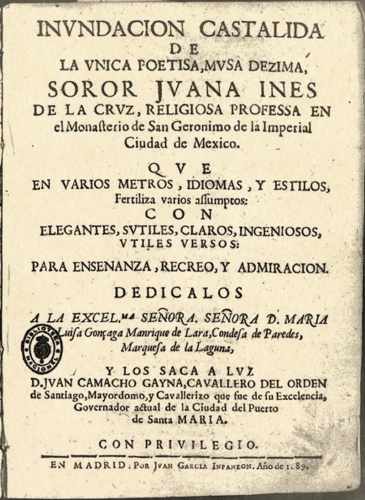
First part of Sor Juana's complete works, Inundación Castálida, Madrid, 1689
Success and controversy
In her sharp-witted poem, Hombres Necios or You Foolish Men, she exposed the double standards of men who blamed women for faults that they caused themselves Even today, the poem will resonate with many, as we can see from a translation of the opening lines:
“You foolish men who lay the guilt on women,
not seeing you’re the cause of the very thing you blame;
“if you invite their disdain with measureless desire
why wish they well behave if you incite to ill.”
Admired for its brilliance and social commentary, the poem also brought backlash from the patriarchy and church of 1680s Mexico, who criticised her for focusing on secular writing.
Undaunted, in 1690 Sor Juana wrote a critique of an old sermon by Jesuit priest António Vieira, who venerated Christ’s self-sacrificing love as opposed to selfish human love. In her Carta atenagórica or Letter Worthy of Athena she challenged Vieira’s interpretation, arguing that divine love is disinterested, whereas human love seeks to be loved in return. The debate demonstrated that women could employ complex theological arguments.
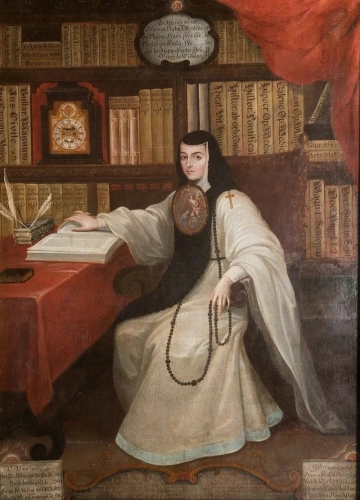
Sor Juana Inés de la Cruz, painting by Miguel Cabrera, c. 18th century; in the National Museum of History,
Chapultepec Castle, Mexico City
Carta atenagórica, widely believed to have been commissioned by the Bishop of Puebla, was intended to remain private. He published it without her consent under the pseudonym "Sor Filotea", discrediting Sor Juana, criticising her intellectualism and warning her to focus on the devotional subject matter befitting a nun.
Women could employ complex theological arguments
Sor Juana fiercely defended herself in the famous Respuesta a Sor Filotea de la Cruz or Reply to Sister Philothea. In it she championed women’s right to learn, read, write and to teach, and criticised the church for neglecting their education. Since God, she argued, had given women intellectual curiosity they should use it to understand divine truth, and further insinuated that universities did not have the monopoly on intellectualism:
"One can perfectly well philosophise while cooking supper."
The Respuesta’s groundbreaking and accessible arguments led it be recognised as one of the first feminist manifestos.
Censorship and punishment
Repercussions followed, however. Although Sor Juana continued to produce work of outstanding quality until about 1694, the male-dominated church viewed her outspokenness as “sinful pride”. She was coerced into abandoning her secular studies and sold her vast library and all her scientific and musical instruments. No longer permitted to publish, even the reading of her publications was prohibited by the Church. Moreover she was obliged to sign various confessions. This she did in her own blood, often with the phrase "I, the worst of all women", as an act of self-deprecation and obedience. Until her death in 1695 following the outbreak of an epidemic, she focused solely on religious activities.
The male-dominated church viewed her outspokenness as “sinful pride”
Impact on feminism, social justice and theology
Sor Juana composed several pieces in Nahuatl – the language of the Aztec people – as well as in the vernacular of African slaves. She regarded indigenous religions as a foreshadowing of Christianity, appreciating their marginalised culture – in a society that valued the colonial hierarchy – and paving the way for later Mexican writers. Furthermore, her belief in universal education, regardless of social status or ethnic background, underscored her vision of the power of education to shatter social and gender barriers.
Sor Juana studied theology and philosophy, unlike most nuns who wrote on mystical subjects. She strove for “sacred theology”, exploring the interconnectedness between humanity and its relationship with God, and combined faith with an enduring passion for knowledge.
The legacy of Sor Juana
Despite the church’s determined censorship that resulted in so few of her works surviving, Sor Juana left an abiding literary legacy. At the time, she was the most widely published and successful literary writer in Spain's empire. Today she is considered one of the most important writers and feminist theologians of the Latin American colonial age, and the intellectual rigour of her work comparable to Western philosophers.
Sor Juan’s pioneering writing on women's intellectual emancipation challenged the patriarchy’s limiting views and led the way for coming generations. In addition, her advocacy for language rights and social justice, and the connection between indigenous religious traditions and ecological protection were equally trail blazing.
She remains a national icon in Mexico to this day
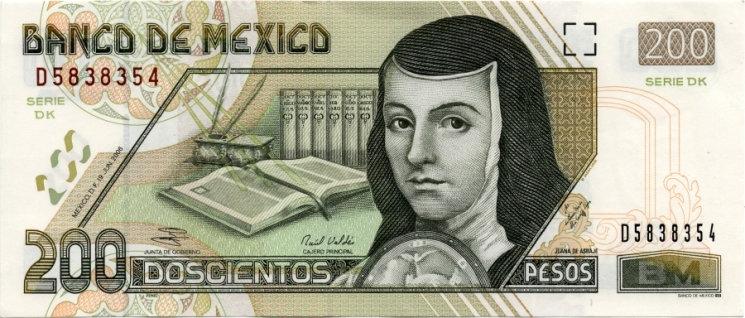
Sor Juana’s image on 200-pesos Mexican note
Not only a symbol of early feminism, Sor Juana has emerged as a figure of LGBT history in Latin America as evidenced by her passionate love poems. She remains a national icon in Mexico to this day, eliciting pride and fascination. Her image is ubiquitous, found on the 200-pesos note, banners, murals and graffiti around cities.
Most importantly, Sor Juana recognised that intellectual life is not separate from everyday life or spiritual life, highlighting the need for both intellect and spirit. In this her legacy is universal and enduring.
By Thérèse Barton
The views expressed in this article are not necessarily those of Spirit of the Rainbow.
If you enjoyed this article, share it with a friend. And why not sign up for our newsletter?
Popular posts
You might also like
Email Newsletter Our latest articles and offers delivered straight to your inbox.