
This is the story of a man who wouldn’t fit into a box. In an age of increasingly entrenched and intolerant religious beliefs, his was a free spirit. The story of his life is one of searching, evolving, awakening till he arrived at an understanding of the spiritual world that we would recognise today. Yet in his time was denounced by the Catholic Church as a heretic and his books were burnt; and the Protestant leader Martin Luther called him "the devil's most cherished slanderous mouth".
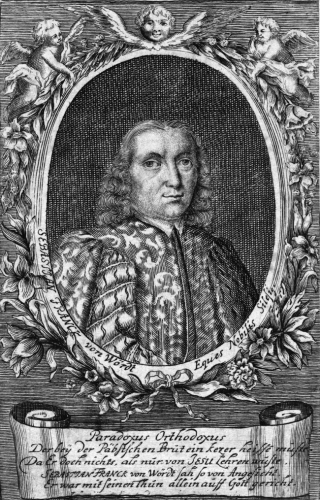
Sebastian Franck (1499 – c. 1543)
Sebastian Franck was born in turbulent times. As a teenager he witnessed the Church split between Catholics and Protestants and the growth of even more radical religious groups like the Anabaptists; prosecutions for witchcraft intensified in waves that lasted for over 250 years and led to the deaths of at least 50,000 people, mainly women; religious intolerance and fear were fuelled by conspiracy theories; the Ottoman Turks, the greatest Islamic force of the age, were at the gates of Vienna; some believed that the world was coming to an end, with a final Apocalyptic battle between the forces and good and evil imminent.
"the devil's most cherished slanderous mouth"
“The Long and Winding Road”
From the first, Sebastian Franck had a spiritual calling. He became a Catholic priest but soon switched the Protestant or ‘Reformed’ ministry in 1525 feeling they were closer to God’s purpose, becoming a pastor near Nuremberg. For a while he seems to have been an entirely orthodox Lutheran, and his spiritual quest could have ended there as it did for many religious reformers. But Sebastian Franck became frustrated with the lack of progress the new Reformed Church was making: lives were not being transformed by its teaching; the clergy needed to set a better example.
Franck was becoming restless. In March 1528, he married Ottilie Beham, described as “a woman of rare gifts” by Professor Rufus Jones in his Spiritual Reformers in the 16th & 17th Centuries. Ottilie seems to have sympathised with religious radicals and may have supported Sebastian in his move away from the established Lutheran doctrine. In any event, Franck resigned as a Lutheran pastor and moved to Nuremberg, a large Protestant city. His spiritual adventures were about to take off.

There he translated the Latin Chronicle and Description of Turkey (1530), a story based on the experiences of an escaped Transylvanian Christian slave to which he added his own commentary. Working on the text, Franck came to see the possibility of spirituality outside the Christian religion: some amongst the Turks, he wrote, are true children of God. Sebastian Franck took the divisions within Islam and Christianity as signs that none are truly on the Divine path. Instead, he called for a new church to:
“Clear out of the way all outward preaching, ceremonies, sacraments, the ban, and callings as unnecessary, and simply collect an invisible, spiritual church in unity of the Spirit and belief among all people.”
And so he gave a voice to a vision of a spiritual coming together of all the peoples of the world without the need for all the institutional paraphernalia of a formal Church, with its rules, doctrines and rituals. Today, it’s an idea we may be familiar with, but in the 16th century it was astonishingly radical.
Franck’s search led him away from accepted doctrine.
The following year Sebastian Franck decided to move to Strasbourg, a centre for religious reformers and radicals of every kind. The Protestant authorities were relatively tolerant, as long as they felt the established religion wasn’t threatened.
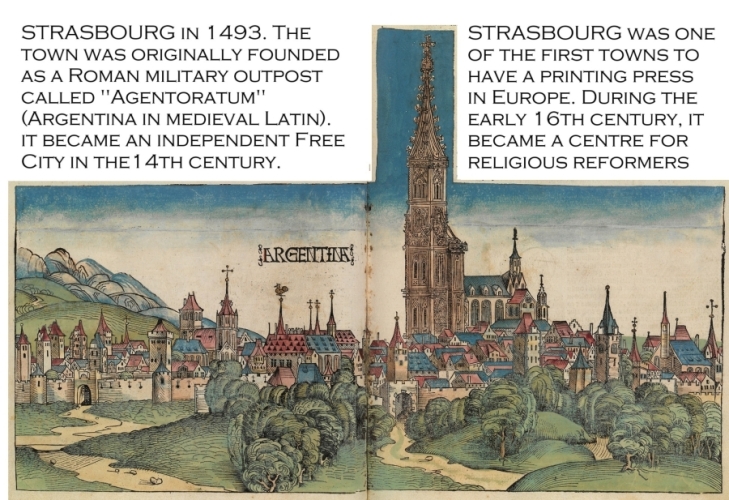
Strasbourg: Woodcut of Strasbourg from the Nuremberg Chronicle by Michel Wolgemut, Wilhelm Pleydenwurff (Text: Hartmann Schedel). Wikipedia Commons.
But Franck’s search led him away from accepted doctrine. In 1531 he published his Chronicle, Book of Time, and Historical Bible which challenged the conventional theology of the day: he recognised the spiritual wisdom of pagan thinkers, such as Socrates, Plato and Hermes Trimegistus; he argued that many accused of “heresy” were in fact bearers of spiritual truths. He asserted what was to become a constant theme in his work: listening to the Spirit of God within each of us:
“We ought always in all matters to notice what God says in us, to pay attention to the witness of our hearts, and never to think or act against our conscience.”
This was in stark contrast with the Catholic Church which claimed that spiritual authority came from the Pope; and the Lutherans who said it was to be found in the Bible – in both cases, sources outside the individual. Franck placed it within each person. Listening to God within made all religious doctrine redundant; and it made the case for freedom of conscience.
All this was very provocative to the authorities. As the contemporary historian Patrick Hayden-Roy wrote, “the air may have been freer in Strasbourg but there was reform to defend, and the reformers saw enemies on many sides.” Franck had managed to offend both the religious and political establishment and was seen as a troublemaker. He was arrested and imprisoned, and his book confiscated. Franck was then released and expelled with his family from the city in December 1531.
Crisis and Opportunity
Franck tried his hand as a soap maker, first at Esslingen, selling his produce at the weekly markets in Württemberg but he struggled to make a living. As he explained:
“My trade and handiwork were not customary in Württemberg, where almost alone the nobility, and very few of the citizens, are in the habit of washing with soap.”
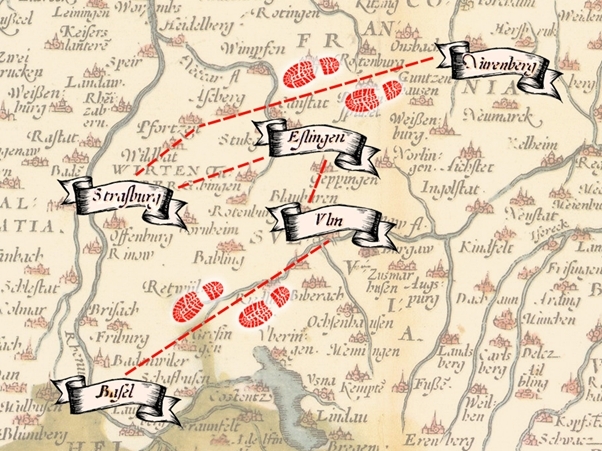
Map of Franck's Travels
Franck moved to the larger town of Ulm in 1533 in search of better markets and printing opportunities. In 1534 he published Paradoxa developing his spiritual ideas. To Protestants, “the Word of God” meant the Bible. To Franck, it was:
“The essence, outpouring, image, picture and appearance of God in all creatures, but especially in all surrendered hearts, illuminating and teaching men from the beginning”.
This Divine guidance of the “inward Light” took precedence over any doctrine, ceremonial or even Scripture. This and other controversial works eventually led to him being expelled from Ulm too. In 1539, Sebastian Franck with his wife and five small children, the youngest only two months old, arrived at Basel, Switzerland, where he worked in book printing. Here he seems to have found some relative peace till his death in 1542.
Franck wrote of the connection of the heart in his vision a spiritual network
Sebastian Franck and Our Spiritual Family
Sebastian Franck attracted few followers in his lifetime let alone start a popular movement as Martin Luther did. However, one of his works has been discovered in the personal library of the Quaker founder, George Fox, and there is evidence of his influence more widely in the radical groups of the mid-17th century Civil War Britain.
More importantly, his voice has come down through the generations and speaks to us in the 21st century. His approach of relying on personal experience to develop an authentic spirituality will resonate with many. His focus on the inner spiritual life rather than outer ritual and obedience to doctrine; listening to our own spiritual guidance from the “God within”; and his belief in universal spirituality – all these are now part of the spiritual life of many millions to today. Above all, Franck wrote of the connection of the heart in his vision a spiritual network:
“Love is the one mark and badge of Fellowship.”
If Spirit of the Rainbow has a patron saint, it is probably Sebastian Franck.
By Simenon Honoré
The views and insights expressed in this article are not necessarily those of Spirit of the Rainbow.
If you enjoyed this article, share it with a friend. And why not sign up for our newsletter?
Popular posts
You might also like
Email Newsletter Our latest articles and offers delivered straight to your inbox.