
The Catholic Church did its level best to destroy not only every last Cathar but every last trace of them and very nearly succeeded. The whole machinery of Church and state – military, administrative, legal and religious – was employed to crush the ‘heresy’ that at one time seemed likely to undermine the power of Catholicism in southern France. Even so, it took over a hundred years to supress Catharism and a few their writings still survived. It is these that give voice to the movement that so terrified the Catholic establishment.
Cathars and Catholics
The Cathar challenge to the Church came above all through the power of example, of living the life of Jesus and his Apostles, which in turn drew so many people to them. Here we have an account of how the Cathars saw themselves, recorded in 1143-44 by Eberwin, Catholic Prior of the Abbey of Steinfeld, writing to St Bernard of Clairvaux.
Of themselves they say: "We are the poor of Christ, who have no fixed abode and flee from city to city like sheep amidst wolves, are persecuted as were the apostles and the martyrs, despite the fact that we lead a most strict and holy life, persevering day and night in fasts and abstinence, in prayers, and in labour from which we seek only the necessities of life. We undergo this because we are not of this world. But you, lovers of the world, have peace with it because you are of the world. False apostles, who pollute the word of Christ, who seek after their own interest, have led you and your fathers astray from the true path. We and our fathers, of apostolic descent, have continued in the Grace of God and shall so remain to the end of time. To distinguish between us and you Christ said, ‘By their fruits you shall know them’. Our fruits consist in following the footsteps of Christ.”
The Cathar challenge to the Church came above all through the power of example
The assertion by the Cathars that they are the true church, seeking to follow in the footsteps of Jesus in their daily lives, is a constant theme in their own writings and was central to their spiritual mission. And their pious behaviour was in stark contrast to the Church’s own reputation for corruption, laxity and greed, especially in southern France which became a Cathar stronghold.
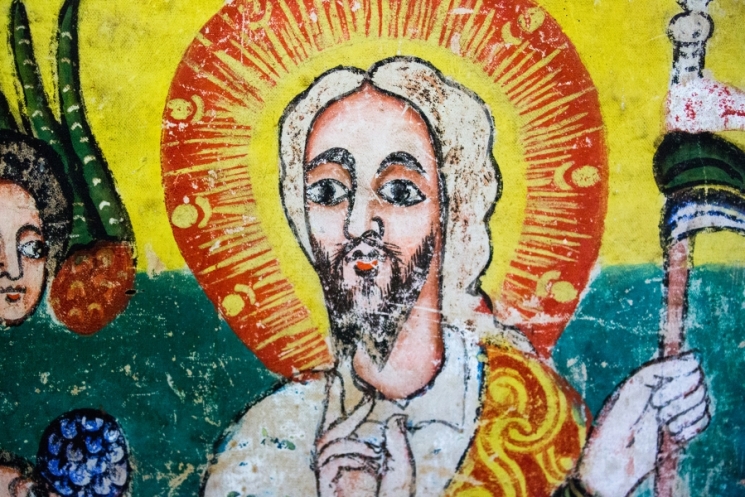
A fresco of Jesus on the wall of the 14th Century Azwa Mariam Monastery, Ethiopia
Cathar Ritual of Initiation: Consolamentum
Probably the most significant surviving Cathar document is the Consolamentum. This was a spiritual baptism initiating a follower into a life as a committed Cathar (parfait or parfaite), rather like a nun or a monk taking their final vows.
This Holy Baptism by which the Holy Spirit is given the Church of God has kept from the Apostles until now, and it has come from the Good Men to the Good Men until now and shall do till the end of the world…
…And know that He has commanded that man shall not commit adultery or murder or lie, that he must not swear any oath, that he shall not seize or rob, nor do to others what he would not have done to himself, that man must forgive whoever wrongs him and love his enemies, pray for his detractors and accusers and bless them; and if anyone strike him on one cheek, turn to him the other also, and if anyone takes away his cloak, to leave him his coat also; and that he should neither judge nor condemn, and many other commandments which the Lord made for His Church
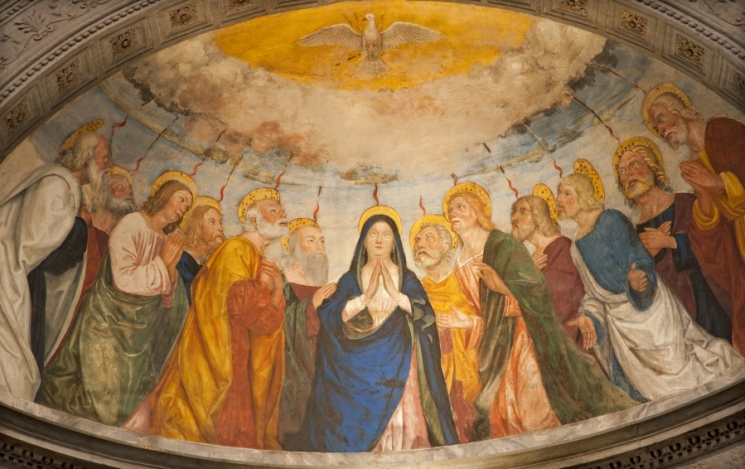
The Holy Spirit. Apse of Chapel Miniscalchi, Saint Anastasia's Church, Verona, Italy
Their success posed a deadly threat to Catholic power.
The “Good Men” referred to was the name used by the Cathars and their supporters about themselves. They asserted an unbroken spiritual line from the Apostles to the Cathars, emphasising how they saw their spiritual calling as staying faithful to Jesus’s original teaching. In doing so they challenged the monopoly on human salvation that the Church claimed for itself and their success posed a deadly threat to Catholic power.
Also striking is that there is no mention of reincarnation or the existence of two gods (Dualism) anywhere in the Consolamentum, and this is the document most regularly used by all Cathars. It suggests that the more abstract ideas for which they are often known were in reality peripheral to their main Christ-centred work.
There is mention of slight variations between women and men in the ritual but no statement of equality between the sexes as is often assumed. You can discover more about this issue in our article on Cathar Women’s Equality.
Cathars and Creation Stories
The two final Cathar writings, The Book of the Two Principles and The Secret Supper of St John (or The Questions of John) are about their belief system. Written by Cathar intellectuals, they are often poured over by theologians and historians. How far they really offer an insight into what made most ordinary Cathars tick is less clear.
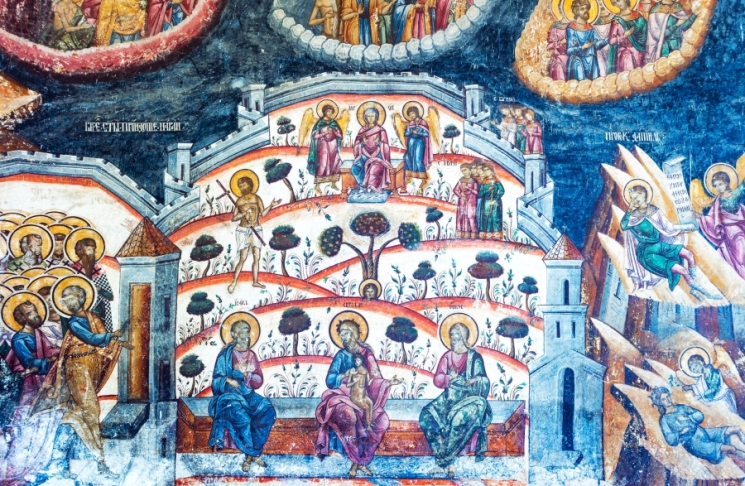
Medieval Fresco from Cozia Monastery, Olt River, Cozia, Romania
The Secret Supper offers an alternative version of the Creation and Fall, with Satan seducing angels away from God, so they became trapped in human form on earth:
“And he (Satan) pondered on making man to serve him; he took clay of the earth and made man like unto himself. And he then bade an angel of the second heaven to enter the body of clay. Of this body he took a part and made another body in the form of a woman and bade an angel of the first heaven to enter into it. And the angels grieved deeply that they thus had a mortal form imposed upon them and that they now existed in different forms.”
It reflects the generally negative view Cathars had of the material world. Whether the precise details of this story impacted them in their mission is less certain.
The Book of the Two Principles is a long, wordy, sometimes self-contradictory treatise which wrestles with the question of good and evil and proposes that the solution lies in the existence of two gods, each representing one of these principles:
Whatever of good is found in the creatures of God is directly from Him and of Him, and He brings the good into being and is its cause…It now follows therefore, that there is another principle, one of evil, who is the source and cause of all pride and wickedness, of all defilement of the people, and of all other evils.
What motivated the Cathars was a simple faith in following in the footsteps of Christ, rather than any doctrinal belief
How representative it is of Cathar thinking is questionable. The author was an “Albanensian”, one of many sects amongst the faction-riven Cathars of Italy, and the book attacks rival Cathar groups. We also know other Cathars believed in one supreme God, with Christ and Satan locked in struggle. Birks & Gilbert argue in their book, The Treasure of Montsegur, that these writings were more philosophical speculations for discussion than fixed articles of faith and we have seen the sources that suggest that what motivated the Cathars was a simple faith in following in the footsteps of Christ, rather than any doctrinal belief. So these writings cannot necessarily be taken as a reliable indicator of what was at the heart of Catharism.
The Spirit and the Letter
Whatever writings of the Cathars have been lost, their spirit lives on. The soul-felt calling to live the life Jesus showed humanity has appeared in many forms through history, of which the Cathars were one shining example.
By Simenon Honoré
The opinions expressed in this article do not necessarily represent the views of Spirit of the Rainbow as whole.
Want to discover more about the Cathars? Watch our series of videos:
Cathar Women: An Untold Story - Video 1
Cathar Women Priests - Video 2
The Light of the Cathars - Video 3
If you enjoyed this article, share it with a friend. And why not sign up for our newsletter?
Popular posts
You might also like
Email Newsletter Our latest articles and offers delivered straight to your inbox.