
If I look back honestly at my teens and early adulthood, I would not have described myself as deeply spiritual. In truth, I was not especially interested. Life was full, busy and structured. It felt easier to keep things rational and contained, with ideas placed neatly into their own compartments. Perhaps, at the back of my mind, I thought there might be something bigger, but there were fewer invisible elements to wrestle with if I just ignored it.
Growing up in Mauritius, spirituality seemed closely tied to religion, rites and a more conservative framework. It often felt formal and prescribed, although it was never imposed on me. At that stage I was immersed in rational Enlightenment thought, reading people such as Voltaire and others who challenged superstition and questioned inherited authority. Moving away from blind belief seemed almost natural. So, I suspect I resisted spirituality because I associated it with dogma rather than inquiry.
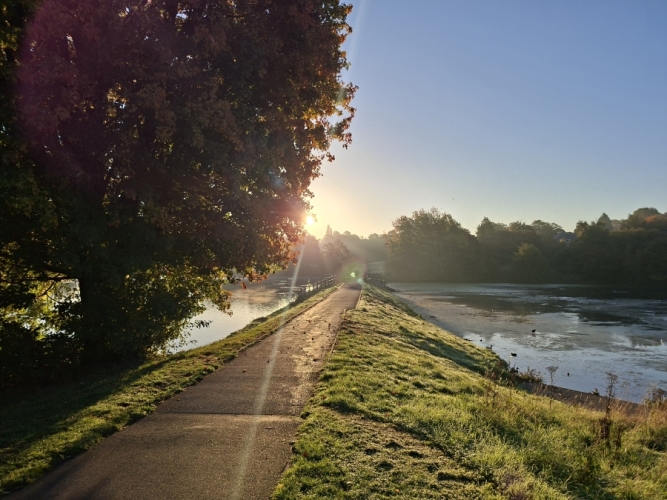
Perhaps in some ways it was fortunate that I was never forced into a spiritual journey. Had it been imposed upon me, I may never have been able to explore it with the same openness. I was not searching for a perfect journey or particular destination. But simply learning to accept how things unfold.
I was not searching for a perfect journey or particular destination
Start of the exploration
The catalyst came during a conversation in a park with a colleague. He asked me why I was not interested in spirituality, and why I did not question myself when I was questioning everything around me. It struck a chord. It was such a simple question. Yet, it unsettled me. It forced me to examine whether my position was conviction, or simply habit, or perhaps the safety of concepts and ideas that could be controlled and mastered.
I began reading about spirituality again, little by little. Because of my love of history, I had long been interested in ancient civilisations. On one of these journeys, I encountered the work of the archaeologist, Marija Gimbutas. Her exploration of Palaeolithic and Neolithic Europe, and particularly her reflections on the relationship between early societies, nature and the sacred feminine, opened a different door for me.
What stayed with me from reading her work was the idea that divinity might once have been experienced not simply as something imposed from above, but as something embedded in the natural world: the earth, its cycles, fertility, animals, water, stone and the rhythms of life itself. The Mother Goddess, in this understanding, was not simply a figure to be worshipped, but part of a wider way of experiencing the relationship between humanity and nature. While reading her work, it opened up new questions: what if our relationship with nature was once understood as something sacred in itself?
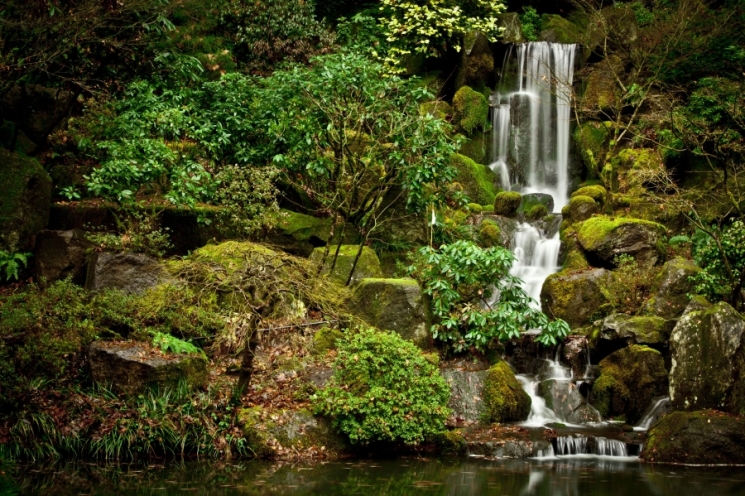
In parallel, my exploration of spiritual Indic traditions deepened. Conversations with a friend from the Gay Indian Network helped enormously. He understood Indian philosophy and shared this with me. I began to appreciate how varied and sophisticated the different schools of thought are. I was discovering different ways of asking questions about consciousness, existence, nature and our place within the universe.
What if our relationship with nature was once understood as something sacred in itself?
I also felt comfortable returning to the Tamil traditions and myths that I was brought up with. The figure of Muruga captured part of my imagination. He embodies youth, wisdom, courage and the overcoming of darkness. He is a warrior of light who defeats ignorance rather than merely enemies. There was also something deeply familiar in the old stories I remembered from my childhood. My grandparents used to say that Muruga was the hills. Looking more deeply into the tradition, I saw the profound association of the divine with the natural landscape, particularly the hills. Again, I found myself returning to the relationship between humanity and nature.
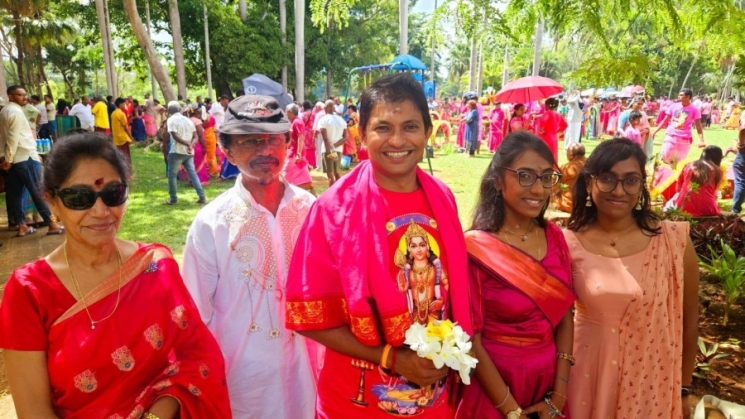
The author (centre) with members of his family during Thaipoosam Cavadee, a festival honouring Muruga
Gimbutas' ideas and Tamil traditions are separated by geography, language and stretches of time. They are not describing the same tradition, nor do they derive from each other. What interests me is they both share the recurring human intuition that nature is not simply a backdrop to human life, but something with which we exist in relationship.
Synthesis of Sounds
Reading parts of the ancient sacred writings of the Vedic corpus, even if only in translation, opened another door. I was struck by the centrality of sound. The idea that creation itself might be understood in vibrational terms. The spoken word not simply descriptive but creative.
In Vedic thought, sound and vibration can have a foundational significance. In Jewish and Christian traditions, the Word is placed at the beginning of creation. These traditions have very different histories and meanings, but I find myself drawn to the recurring human intuition that something subtle and unseen can have profound creative power.What fascinates me is not necessarily that these traditions are identical, but that similar questions appear in very different places.
Today, that awareness makes rituals feel different to me. Even when they have been altered over centuries, and even when later interpretations have been layered upon them, they can still be gestures repeated across generations. They connect us to those who came before us. In that sense, I see ritual as a form of living history – a link to all those who came before us.
Finding balance
When I look across these different civilisations and traditions, another recurring theme appears to me. One that aligns closely with a principle by which I have always tried to live, without necessarily having named it in spiritual terms: one rooted in humanism and dignity. The idea of an inner spark. The responsibility to bring light into darkness. Compassion not as weakness, but as strength. The sense that our humanity carries a responsibility towards others.
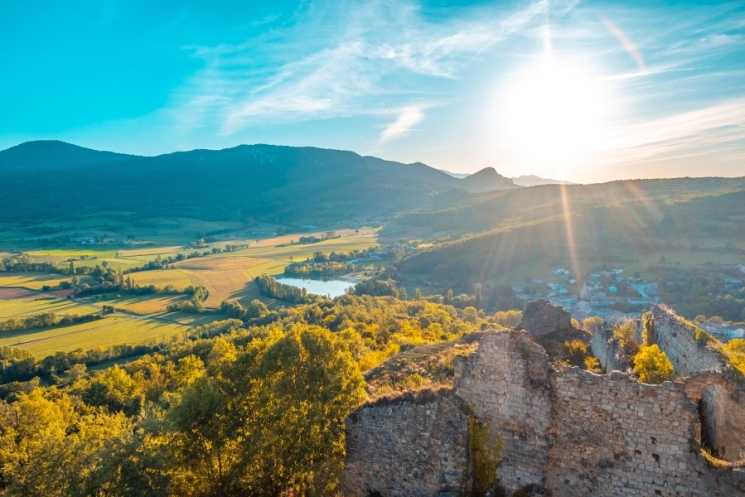
It is as though I have been walking a path that others articulated long ago in different languages.
I see ritual as a form of living history - a link to all those who came before us.
Losing more people recently has sharpened these reflections. Death has a way of stripping away distraction. It brings forward the eternal questions.
Who are we? Where are we going? What persists, if anything? What is the meaning of this fragile and extraordinary existence?
I would not say that I have become religious in a conventional sense. Rather, I feel that I am becoming reconciled with two parts of myself that I once thought had to remain separate: Enlightenment rationality and ancient reverence.
I can question and still wonder. I can remain sceptical without closing doors. I can look at an ancient story and ask what it meant to the people who told it, while also asking what it might mean to me today. And perhaps the most humbling thought of all is that we are part of a conversation far older than ourselves.
I do not claim to have found the answers. In fact, I am increasingly comfortable with the possibility that I may never have them. But I feel less resistant now. More curious. More connected. More willing to stand in the questions.
So where are you on your journey?
By Pliny Soocoormanee
The views expressed in this article are not necessarily those of Spirit of the Rainbow.
If you enjoyed this article, share it with a friend. And why not sign up for our newsletter?
Popular posts
You might also like
Email Newsletter Our latest articles and offers delivered straight to your inbox.